
The blogging landscape has undergone a seismic shift. For the past two decades, the formula for a successful blog was simple, yet grueling: find a niche, research keywords, and spend 10 to 20 hours a week meticulously crafting articles. The “sweat equity” of the blogger was the primary currency. However, as we move through 2026, the barrier to entry has changed. We are no longer in the era of the “manual writer”; we are in the era of the AI-augmented creator.
For modern bloggers, the challenge is no longer just about writing well—it’s about managing the sheer volume of information and the speed of the market. To stay competitive, you must produce high-quality, SEO-optimized, and deeply researched content at a pace that was once humanly impossible.
This is where AI for content creators becomes the ultimate force multiplier. In this comprehensive guide, we will explore how to leverage AI tools for creators to revolutionize your workflow, allowing you to create 10x more content in 10% of the time, all while maintaining the “human soul” that keeps readers coming back.
Part 1: The Philosophy of the Augmented Blogger
Before diving into the tools and tactics, it is essential to understand the mindset shift required for success. Many bloggers view AI with either skepticism (fear that it will replace them) or over-enthusiasm (thinking they can simply “auto-generate” a successful site). Both are traps.
The Shift from Writer to Editor-in-Chief
The most successful bloggers today use AI content creation not as a replacement for their voice, but as a digital staff. In this new paradigm:
- The AI is the Researcher/Drafter: It handles the data collection, the initial structural outline, and the first “raw” draft.
- The Blogger is the Architect/Editor: You provide the unique angle, the personal anecdotes, the fact-checking, and the final stylistic polish.
This “Human-in-the-Loop” model is the only way to satisfy both your human audience and Google’s increasingly sophisticated algorithms.
Understanding E-E-A-T in the Age of AI
Google’s Search Quality Evaluator Guidelines emphasize E-E-A-T (Experience, Expertise, Authoritativeness, and Trustworthiness). Purely AI-generated content often lacks “Experience.” As an augmented blogger, your job is to use AI to handle the “common knowledge” portions of your post while you inject the “Experience” that only a human can provide.
Part 2: Phase 1 – AI-Driven Ideation and Strategic Planning
The first “time-leak” for most bloggers is deciding what to write about. AI for bloggers can reduce this phase from hours of guesswork to minutes of data-driven certainty.
1. Identifying “Information Gaps”
Standard keyword research tools tell you what people are searching for, but they don’t always tell you what’s missing from the current results.
- Strategy: Use AI to analyze the top 10 search results for a keyword. Ask the AI: “Analyze these search results and identify three specific questions or sub-topics that are being ignored or answered poorly.”
- The Workflow: By targeting these “gaps,” you provide what Google calls “Information Gain,” which is a primary ranking factor in 2026.
2. Developing Topical Authority Maps
To rank for high-competition keywords, you need to prove you are an expert in the entire niche.
- AI Tool Utility: Use ChatGPT or Claude to generate a “Topical Map.”
- The Prompt: “I want to be the leading authority on ‘Urban Beekeeping.’ Generate a list of 50 interlinked blog post ideas categorized by beginner, intermediate, and advanced levels, ensuring there is no keyword cannibalization.”
- Result: In 30 seconds, you have a year’s worth of content strategy that is architected for maximum SEO impact.
Part 3: Phase 2 – Deep Research and Fact-Synthesis
Research is the “silent killer” of productivity. It is often where bloggers get distracted or bogged down in tabs.
1. The Power of Real-Time AI Search
Tools like Perplexity AI and SearchGPT have replaced traditional search for the research phase.
- Why it’s faster: Instead of clicking 10 links and reading 10 articles, you ask the AI to synthesize the information.
- Actionable Step: “Summarize the current 2026 regulations for short-term rentals in Tokyo, citing at least three official sources and identifying any recent changes from 2025.”
2. Analyzing Large Datasets and Documents
If you are a blogger in a technical niche (finance, health, tech), you likely deal with long PDFs or whitepapers.
- The Workflow: Upload the document to an AI with a large context window (like Claude 3.5 Sonnet).
- The Prompt: “Extract the key data points from this 60-page report that support the idea that remote work is increasing productivity. Present them as a bulleted list with page references.”
- Time Saved: 3-4 hours of reading reduced to 5 minutes of extraction.
Part 4: Phase 4 – The “Chunking” Method for Drafting
Asking an AI to “write a 2,000-word blog post” is the fastest way to get mediocre content. To create high-quality content in less time, you must use the “Chunking” method.
1. Drafting the “Super-Outline”
Start by asking the AI to create an outline based on a specific framework (e.g., the AIDA model or the Problem-Agitation-Solution framework).
- Key Detail: Ensure the outline includes H2 and H3 headings that are already SEO-optimized.
2. Iterative Drafting
Draft the post one section at a time. This allows you to guide the AI and prevent it from “hallucinating” or becoming repetitive.
- Section 1 (Introduction): Ask the AI for a “hook” that uses a specific emotional trigger.
- Section 2 (Educational): Feed the AI your research notes and ask it to expand them into a conversational explanation.
- The “Voice Injection”: After the AI drafts a section, read it and add one personal sentence. “I remember when I first tried this in 2021, and it completely changed my perspective because…” This small addition is what differentiates your blog from “AI Slop.”
Part 5: Phase 5 – Advanced SEO and Semantic Optimization
Writing is only half the battle; the other half is ensuring the “robots” can understand and prioritize your content.
1. NLP and Entity Optimization
Search engines today look for “entities”—concepts related to your main keyword.
- AI Tools for Creators: Tools like SurferSEO or NeuronWriter use AI to scan the top-ranking pages and provide a list of terms you must include to be considered relevant.
- The AI Hack: Take your draft and the list of NLP terms and tell the AI: “Naturally integrate the following 20 terms into this article without changing the tone or increasing the word count unnecessarily.”
2. AI-Generated Metadata
Writing meta descriptions and alt-text for images is a tedious chore that many bloggers skip.
- The Workflow: Give the AI your final draft and ask for:
- 3 Click-worthy SEO Titles (under 60 characters).
- A compelling Meta Description (under 155 characters) that includes the primary keyword.
- Alt-text for 5 images described in the post.
Part 6: Phase 6 – Visual Content and Media Integration
A blog post without visuals is a wall of text that increases your bounce rate. AI content creation now extends to the visual layer.
1. Custom Featured Images with Midjourney
Stock photos are generic. Midjourney v6 allows you to create high-end, branded imagery that is unique to your site.
- Pro Tip: Use a “Style Reference” (–sref) to ensure every image on your blog has a consistent color palette and artistic feel, building a recognizable visual brand.
2. Turning Blogs into Video (The “Dwell Time” Booster)
Google loves it when users stay on your page for a long time. Embedding a video is the best way to do this.
- The Workflow: Use HeyGen or Synthesia to turn your blog’s “Key Takeaways” into a 60-second video featuring an AI avatar.
- The Result: You provide a “video version” of your post for visual learners, drastically increasing time-on-page metrics.
Part 7: Phase 7 – Repurposing for Social Media (The Multiplier)
The work doesn’t end when you hit “Publish.” To truly scale, you need to be on every platform.
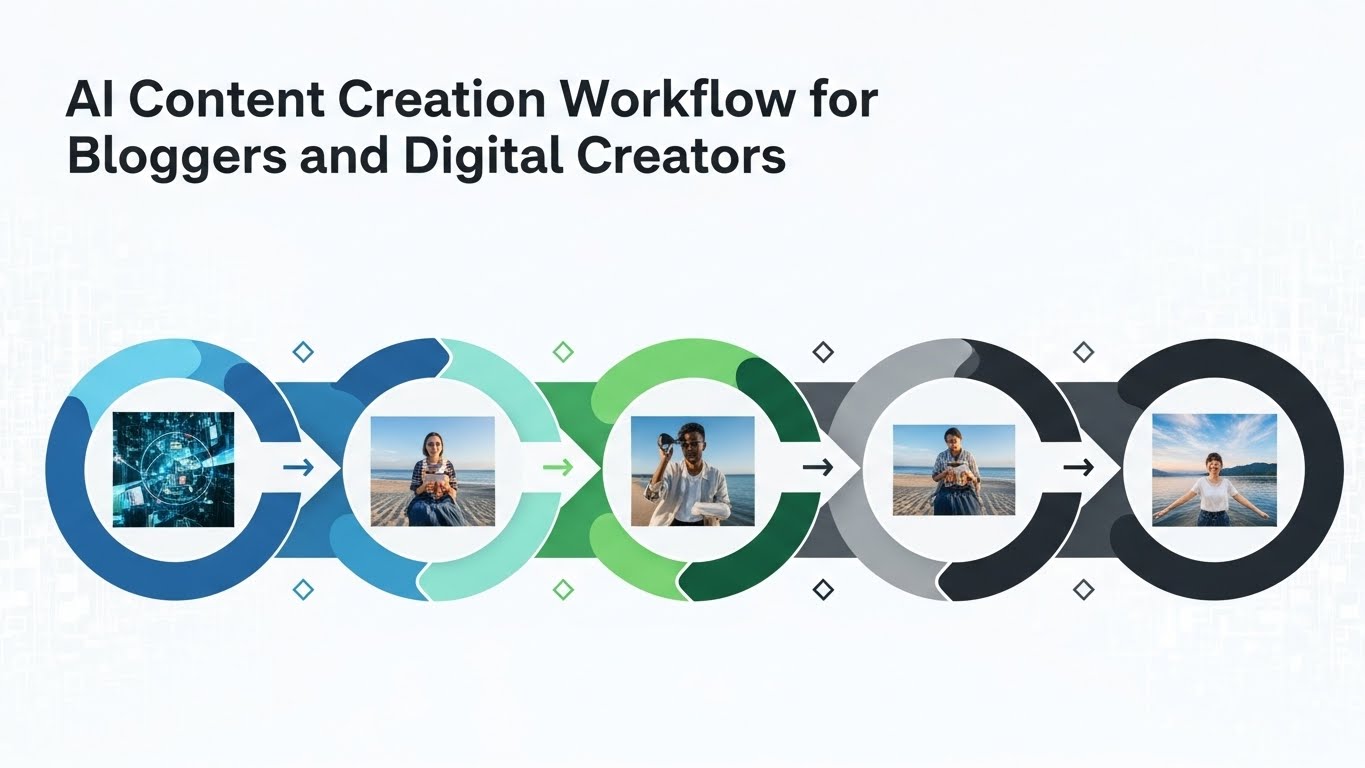
The “Content Waterfall” Workflow
One blog post can be turned into a week’s worth of social media content in under 15 minutes using AI:
- X (Twitter): “Turn this blog post into a 10-post educational thread with a viral hook.”
- LinkedIn: “Summarize the 3 most professional insights from this post into a 200-word update for a B2B audience.”
- Instagram/TikTok: Use OpusClip or Munch to find “short-form” scripts within your content.
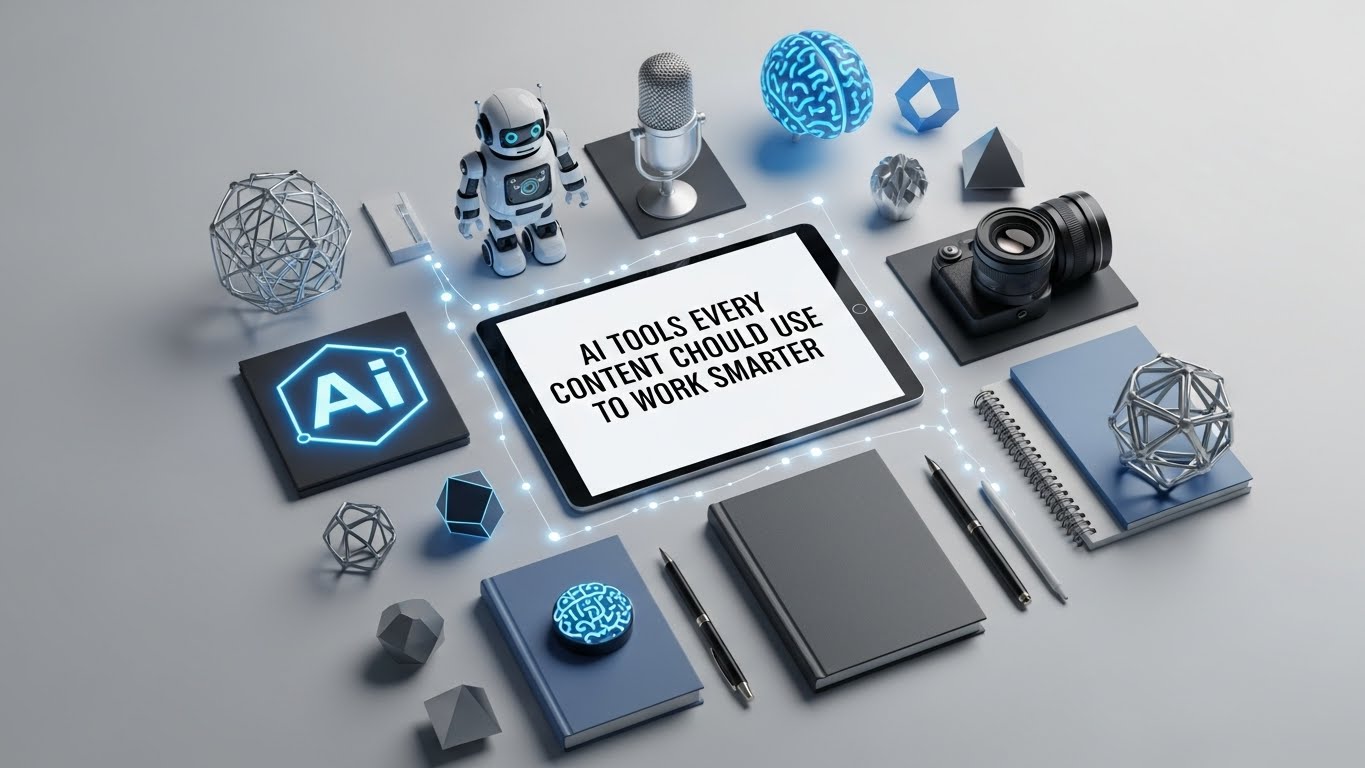
Part 8: Essential AI Tools for Bloggers (The 2026 Stack)
To build a “More Content, Less Time” system, you need the right tools. Here is the professional recommendation for 2026:
1. The Foundation (Text & Logic)
- Claude 3.5 Sonnet: The current leader for creative writing and nuanced drafting.
- ChatGPT Plus (GPT-4o): Best for data analysis, coding snippets, and general brainstorming.
2. The Research Specialist
- Perplexity AI: Essential for factual research and sourcing.
3. The SEO Optimizer
- SurferSEO: The gold standard for ensuring your AI content creation actually ranks on the first page.
4. The Visual Studio
- Midjourney: For high-end, unique imagery.
- Canva Magic Studio: For quick social media graphics and YouTube thumbnails.
5. The Audio/Video Multiplier
- ElevenLabs: To create an “Audio Version” of your blog post (great for accessibility and SEO).
- Descript: To edit any video or audio components by simply editing the text.
Part 9: The “Quality Control” Checklist (The Human Element)
To ensure your AI for content creators strategy doesn’t backfire, you must put every post through this “Human-in-the-Loop” filter:
- Fact-Check Audit: Did the AI mention a date, a price, or a name? Verify it. AI can be confidently wrong.
- The “Cliche” Purge: Remove AI-isms. Words like “tapestry,” “delve,” “leverage,” and “in the rapidly evolving landscape” are red flags to readers and search engines.
- Formatting for Scannability: AI often writes long, dense paragraphs. Manually break these up. Add bullet points. Use bold text for key terms.
- The Opinion Check: Does the article have a point of view? AI is designed to be neutral. As a blogger, your value is your opinion. Don’t be afraid to take a stand.
Part 10: Monetization – How Efficiency Becomes Profit
Why does “More Content in Less Time” matter? Because in the digital economy, Volume x Quality = Income.
1. Scaling Affiliate Revenue
With AI, you can produce 5 product reviews a week instead of 1. Over a year, this “surface area” of affiliate links leads to a compounding increase in passive income.
2. Sponsorships and Authority
High-frequency, high-quality posting makes you a “thought leader” in your niche. This attracts brands for sponsorships and speaking engagements.
3. Digital Product Launching
Use the time you saved on blogging to create a digital product (e-book, course, or template). Use AI to help structure the course modules and draft the sales page, allowing you to launch a new revenue stream while your blog continues to grow.
Conclusion: The Future of the Blogger is Augmented
We are moving toward a world where the “average” content will be handled entirely by machines. If you continue to blog like it’s 2015—relying solely on manual research and slow writing—you will be left behind.
However, if you embrace AI for content creators, you are not just a blogger anymore; you are a media mogul. You have the research power of a library, the design skills of a studio, and the output speed of a newsroom—all contained within a few browser tabs.
The goal of AI for bloggers is not to remove the human; it is to amplify the human. By automating the mundane, you free your mind to do what it does best: create, connect, and inspire.
The era of the “starving artist” blogger is over. The era of the high-output, AI-powered creator-preneur has begun. It’s time to start your first augmented workflow today.
Key Takeaways for the Reader:
- Volume is the New SEO: AI allows you to cover “Topical Maps” faster, signaling authority to Google.
- Chunking is Essential: Never ask AI to write a whole post; build it section by section for quality.
- Human Premium: Your personal stories and “Information Gain” are what prevent your content from becoming “AI Slop.”
- Repurpose or Die: Use the “Content Waterfall” to ensure your blog post reaches every corner of the internet.