
In the early 2020s, blogging was a marathon of endurance. A high-quality, 2,000-word pillar post took an average of 15 to 20 hours to research, draft, edit, and optimize. If you wanted to run a successful niche site, you were either a full-time writing machine or a wealthy agency owner.
Fast forward to 2026. The “Content Treadmill” has accelerated, but the tools have evolved even faster.
Today, AI content creation isn’t about clicking a button and getting a mediocre article. It’s about “Cyborg Writing”—a high-speed collaboration between human intuition and algorithmic efficiency. If you aren’t using AI to speed up your workflow, you aren’t just behind; you’re invisible.
This 6,000-word guide will walk you through the exact framework for building a high-speed content engine that ranks, converts, and sounds like a human wrote it.
Part 1: The New Reality of AI Content Creation
The Death of the “Prompt-and-Dump”
In 2024, people were still trying to “trick” Google with raw AI text. By 2026, those sites have mostly been wiped out. Search engines now prioritize Information Gain—the measure of how much new value your post provides compared to what’s already out there.
To create content faster, you cannot let the AI do the thinking. You must use AI to do the heavy lifting.
The 20/80 Rule of 2026 Blogging
- 20% Human: Strategy, unique insights, personal anecdotes, fact-checking, and “the hook.”
- 80% AI: Researching data points, outlining, drafting sections, SEO optimization, and formatting.
Part 2: Phase 1 – Hyper-Speed Ideation and Strategy
The biggest time-sink in blogging isn’t the writing; it’s the deciding what to write.
1. AI-Driven Trend Forecasting
Instead of using static keyword tools, 2026 bloggers use AI agents that monitor “Live Web” data.
- The Workflow: Use a tool like Perplexity or Google Gemini to ask: “What are the emerging ‘micro-trends’ in [Niche] that have high search interest but no comprehensive guides yet?”
- The Result: You find topics 2 weeks before they hit the mainstream tools like Ahrefs or Semrush.
2. The “Content Gap” Analysis
Use AI to analyze your competitors’ top-performing posts.
- The Prompt: “Analyze these three URLs [Insert Competitor Links]. Identify the ‘blind spots’ or questions that users are asking in the comments that these articles failed to answer.”
- Speed Hack: This gives you a winning angle for your post in under 3 minutes, a task that used to take hours of manual reading.
Part 3: Phase 2 – Research at the Speed of Light
In 2026, we no longer spend hours in Google Search. We use Retrieval-Augmented Generation (RAG).
1. Creating a Research Synthesis
Using tools like Claude 4 or NotebookLM, you can upload 10-15 PDFs, whitepapers, or transcripts.
- The Action: “Summarize the core arguments, key statistics, and controversial opinions found in these sources. Cite the specific source for every statistic.”
- The Time Saved: 4-6 hours of academic or technical research condensed into 5 minutes.
2. Fact-Checking in Real-Time
AI content creation is prone to “hallucinations.” To move fast without being wrong, use a dedicated fact-checking agent.
- Pro Tip: Use an AI that has a “search-grounded” architecture. Before you move to drafting, ask: “Verify the three claims made in this paragraph against the latest 2026 data.”
Part 4: Phase 3 – The Snowflake Outlining Method
A blog post is only as fast as its outline is deep. If your outline is vague, the AI will write fluff.
1. The Recursive Outline
Start with a 3-point bulleted list and ask the AI to expand it into a 15-point “Detailed Architecture.”
- Crucial Step: Define the User Intent for every H2 header. Tell the AI: “Under this header, the user is looking for a ‘Quick Win.’ Keep the advice actionable.”
2. Matching the Search Intent
Search engines in 2026 are highly sensitive to “Intent Matching.”
- The Workflow: Paste the top 3 results for your keyword into your AI. Ask: “What is the ‘Psychological State’ of a user searching for this? Are they in ‘Problem-Aware’ mode or ‘Solution-Aware’ mode? Structure my outline to mirror their journey.”
Part 5: Phase 4 – drafting (The “Cyborg Writing” Technique)
Never ask an AI to “Write a 2,000-word blog post.” It will be repetitive, boring, and clearly robotic.
1. Section-by-Section Drafting
To maintain high quality, draft one H2 at a time.
- The Prompting Framework:
- Context: “We are writing the ‘How-To’ section of the guide.”
- Data: “Use the research points about [Specific Stat] we gathered earlier.”
- Constraint: “Do not use the word ‘delve,’ ‘unleash,’ or ‘tapestry.’ Use short, punchy sentences.”
- Personalization: “Include a sentence that mentions my personal experience of failing at this task in 2023.”
2. Maintaining Your Unique Voice
By 2026, most advanced bloggers have a “Style Persona” file.
- The Hack: Upload three of your best-performing human-written articles to the AI. Ask: “Analyze my rhythm, sentence length variability, and vocabulary. Create a ‘Voice Profile’ for me. Apply this profile to every paragraph you draft.”
Part 6: Phase 5 – Advanced SEO for 2026
SEO is no longer about keyword density; it’s about Semantic Saturation.
1. NLP and Entity Optimization
Tools like Surfer SEO and NeuronWriter have integrated deeply with LLMs.
- The Workflow: As you draft, the AI should be monitoring a list of “Entities” (related concepts). If you are writing about “Coffee Roasting,” the AI should automatically nudge you to include “Maillard reaction,” “First crack,” and “Hearth temperature.”
2. AI-Generated Internal Linking
Speed up your publishing by asking AI to map your new post to your old ones.
- The Prompt: “Here is my sitemap. Suggest 5 places in this new article where I can naturally link to my previous posts about [Topic X] and [Topic Y]. Provide the exact anchor text.”
Part 7: Phase 6 – Multi-Modal Content (The “Visual” Speed-Up)
A blog in 2026 is incomplete without custom visuals. AI content creation now includes the “Visual Layer.”
1. Custom Infographics
Use Canva’s AI or Midjourney to create custom diagrams.
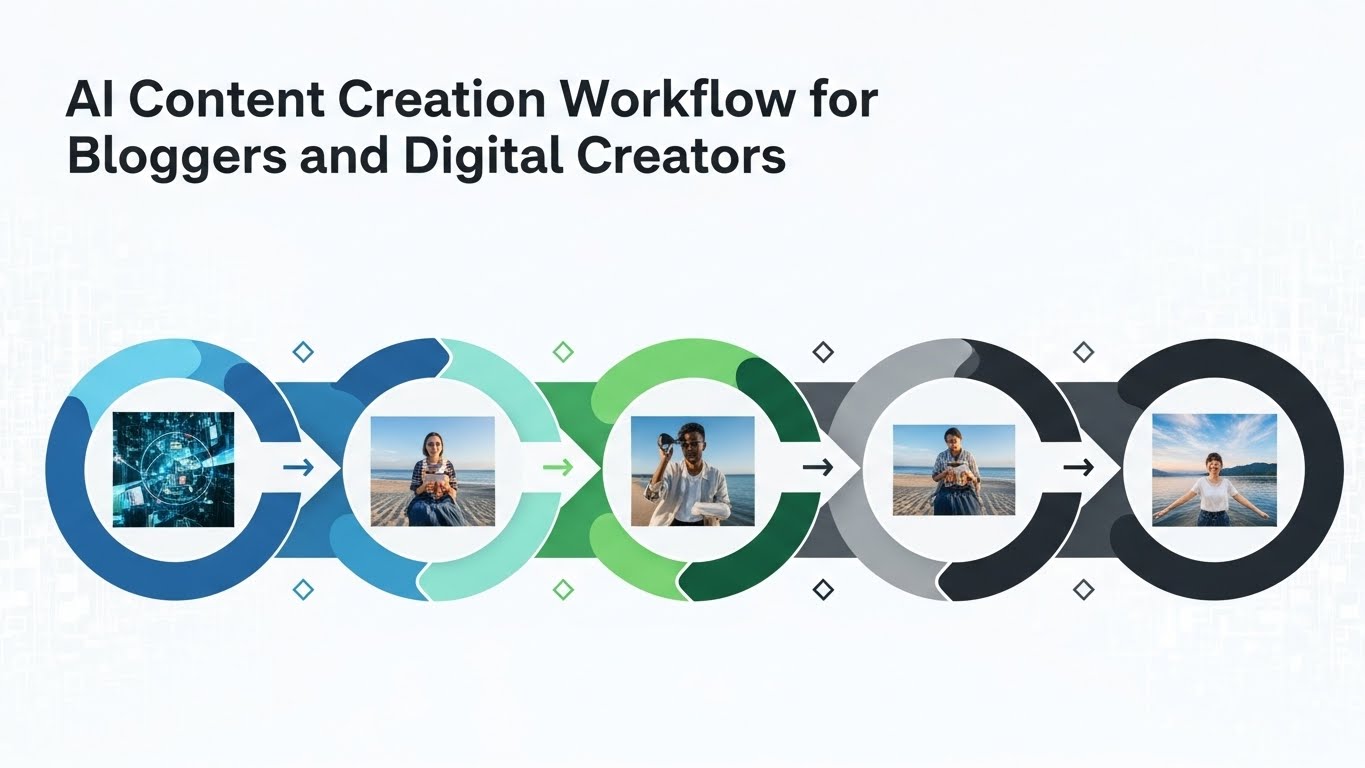
- Speed Hack: Take your blog outline and ask: “Summarize the ‘Process’ section of this blog into a 4-step flowchart description.” Then, feed that description into an AI design tool.
2. AI Featured Images
Stop using the same Unsplash photos as everyone else.
- The Prompt: “Create a cinematic, high-resolution image of a futuristic writing studio that conveys the feeling of ‘Speed’ and ‘Intelligence.’ Use a palette of deep blues and neons.”
Part 8: Phase 7 – The “Humanizing” Edit (The Non-Negotiable Step)
This is where the 20% of human effort happens. This is the difference between a post that ranks #1 and a post that gets flagged as spam.
1. The “Experience” (EEAT) Injector
Scan your AI draft for “The I Factor.”
- The Rule: Every 300 words, there should be a sentence that only a human could write.
- “When I tried this last Tuesday, I noticed that…”
- “Most experts say X, but in my 10 years of blogging, I’ve found that Y is actually true.”
2. Trimming the AI Fluff
AI loves to summarize what it just said.
- The Edit: Delete the first sentence of every paragraph and the last sentence of every section. Usually, the “meat” is in the middle.
3. The Read-Aloud Test
In 2026, voice search and audio-blogs are massive. If your AI content sounds weird when read aloud by a text-to-speech tool (like ElevenLabs), it’s not ready.
Part 9: Phase 8 – Scaling the Workflow (Automation)
Once you have the process down, you can move from 1 post a week to 1 post a day.
1. The “Content Repurposing” Loop
The moment your blog is finished, the AI content creation process shouldn’t stop.
- The Automation:
- “Turn this blog into a 10-slide LinkedIn Carousel script.”
- “Write a 3-part email sequence to promote this post.”
- “Generate a script for a 60-second TikTok summary.”
2. Using AI Agents for CMS Uploads
Use Zapier or Make.com to connect your AI writing tool directly to WordPress.
- The Result: The AI drafts the post, optimizes the meta-description, generates the alt-text for images, and saves it as a “Draft” in your dashboard. You just walk in, do a final 15-minute “Human Check,” and hit Publish.
Part 10: Conclusion – The Future of the Fast Blogger
The fear that AI will replace bloggers is misguided. AI is replacing the process of writing, but it cannot replace the purpose of writing.
By 2026, the successful bloggers are those who have mastered AI content creation as a skill set. They are the directors of a digital orchestra. They spend their time on high-level strategy, original experiments, and building community, while the AI handles the grueling hours of drafting and SEO tagging.
Your Action Plan for this week:
- Stop writing in a blank Google Doc. Start by building a Research Synthesis in an AI tool.
- Audit your voice. Create your “Style Persona” file so your AI drafts don’t sound like a textbook.
- Implement the Section-by-Section method. Watch your quality skyrocket as your drafting time plummets.
The world doesn’t need more content; it needs better content, faster. With these AI tools and workflows, you are now equipped to provide exactly that.