The digital landscape is undergoing its most significant transformation since the invention of the search engine. For decades, the “creator economy” was defined by a linear relationship between time and output. If you wanted to publish more, you had to work longer hours or hire a team. This bottleneck—the limit of human bandwidth—has effectively been shattered.
We have entered the era of the AI-augmented creator.
Today, the most successful bloggers and digital entrepreneurs are not those who are “writing” in the traditional sense, but those who are directing AI to handle the mechanical heavy lifting of production. By integrating AI for content creators into a structured, repeatable workflow, you can increase your output by 10x while simultaneously improving the strategic depth of your work.
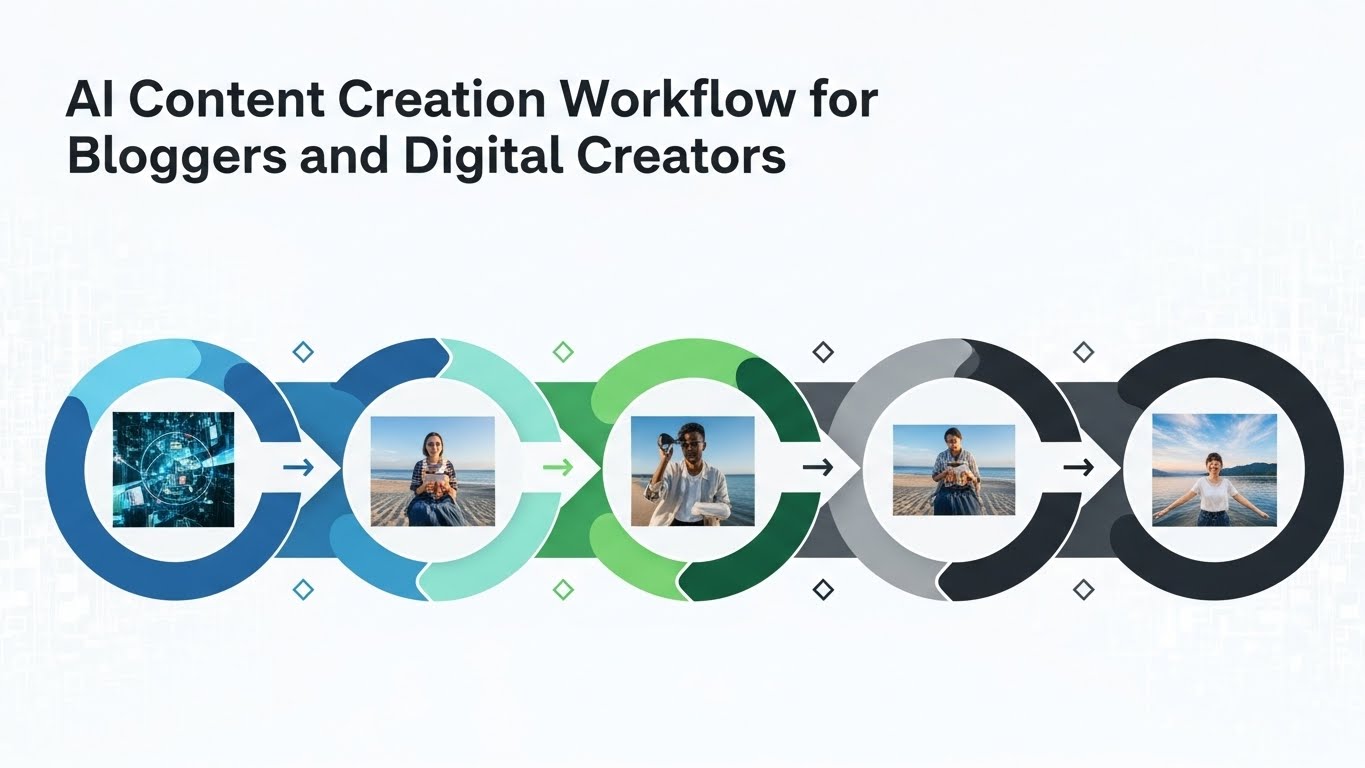
This comprehensive guide will walk you through a professional-grade AI content creation workflow designed to maximize efficiency, protect your search engine rankings, and ultimately drive higher online income.
Part 1: The Philosophy of the Augmented Workflow
Before we dive into the specific tools, we must address the “AI Slop” problem. In 2026, the internet is flooded with low-quality, generic AI text. Search engines like Google have responded by prioritizing “Information Gain”—content that adds something new to the conversation.
To succeed, your workflow must follow the 80/20 Rule of AI:
- 80% AI execution: Research synthesis, initial drafting, formatting, SEO optimization, and distribution.
- 20% Human intelligence: Strategy, personal anecdotes, fact-checking, and final “voice” injection.
This workflow is not about replacing the blogger; it is about freeing the blogger from the mundane to focus on the masterful.
Part 2: Phase 1 – Strategic Ideation & Topic Clustering
The first step in AI for bloggers isn’t writing; it’s architecting. Most creators fail because they choose topics based on “gut feeling.” AI allows us to choose topics based on data and topical authority.
1.1 Predictive Trend Analysis
Instead of using standard keyword tools, use AI to identify “Content Gaps.”
- The Workflow: Feed an AI like Claude 3.5 Sonnet or ChatGPT the URLs of your top three competitors.
- The Prompt: “Analyze these websites and identify five sub-topics they have covered shallowly or missed entirely. Focus on ‘long-tail’ questions that users are asking on Reddit or Quora related to these topics.”
- Result: You now have a list of topics where you can provide “Information Gain.”
1.2 Topic Clustering for Authority
Google rewards sites that show “Topical Authority.” You shouldn’t write a single post; you should write a “cluster.”
- The Workflow: Use AI content creation tools to generate a “Topical Map.” If your main topic is “Sustainable Living,” ask the AI to break it down into clusters: Waste Reduction, Ethical Fashion, Renewable Energy, and Urban Gardening.
- Result: A 3-month content calendar where every post is interlinked, signaling to search engines that you are an expert in the field.
Part 3: Phase 2 – Deep Research & Information Synthesis
The most time-consuming part of blogging is the research phase. Traditionally, this involved hours of scrolling through search results and academic papers.
2.1 The AI Research Assistant
Tools like Perplexity AI and SearchGPT have changed the game. They don’t just give you links; they synthesize the information for you.
- Actionable Step: Instead of a Google search, ask: “Provide a summary of the current scientific consensus on [Topic], including three conflicting viewpoints and five recent statistics with citations.”
- The “Context Window” Advantage: In 2026, you can upload entire 50-page PDFs or industry reports into your AI. Ask it to: “Extract the key data points that contradict popular myths in this industry.”
2.2 Fact-Checking & Bias Detection
AI can hallucinate. A professional workflow includes a “Validation Step.”
- AI for creators tip: Use a second, different AI model to fact-check the first. Copy your draft into a new window and say: “Identify any factual claims in this text and verify them against high-authority news sources or academic databases.”
Part 4: Phase 3 – The Architect’s Draft (The “Chunking” Method)
One of the biggest mistakes in AI content creation is asking an AI to “write a 2,000-word blog post.” This results in fluff and repetition. The professional approach is “Chunking.”
3.1 Structural Outlining
Ask the AI to generate a “Structural Framework” based on proven copywriting formulas like PAS (Problem-Agitation-Solution) or AIDA (Attention-Interest-Desire-Action).
- Prompt: “Create an H2/H3 outline for a deep-dive guide on [Topic]. Ensure the flow follows a logical progression from beginner concepts to advanced strategies.”
3.2 Iterative Section Generation
Draft your post section by section.
- Section 1 (The Hook): Focus on emotion and the “Why.”
- Section 2 (The Data): Feed the AI your research notes from Phase 2 and ask it to expand them into a coherent narrative.
- Section 3 (The Personal Inject): This is where you, the human, step in. Write three sentences about a personal experience related to the topic. Ask the AI: “Incorporate this personal story into the following section while maintaining the established tone.”
Part 5: Phase 4 – Visuals, Media & Branding
A wall of text is a bounce-rate trap. AI tools for creators have made high-end visual production accessible to solo bloggers.
4.1 Custom AI Imagery
Avoid stock photos that look like everyone else’s.
- Midjourney v6: Use it to create “Hero Images” that match your brand’s specific aesthetic.
- Canva Magic Studio: Use AI to “Magic Expand” images or create social media carousels from your blog headers automatically.
4.2 The Video Component
Every blog post should have a video element to improve “dwell time” (how long a user stays on your page).
- HeyGen: Turn your blog summary into an AI-avatar video where a digital spokesperson “teases” the content.
- Lumen5: Automatically turn your blog’s H2 headings and key sentences into a “slideshow video” with background music and captions.
Part 6: Phase 5 – SEO & Semantic Optimization
Writing for humans is the priority, but writing for algorithms is the reality. AI for bloggers must include a technical SEO layer.
5.1 NLP (Natural Language Processing) Integration
Search engines look for “Entities” (related terms). If you’re writing about “Coffee,” you should also mention “Grind size,” “Arabica,” “Brewing temperature,” and “Extraction.”
- Tool: SurferSEO or NeuronWriter.
- The Workflow: Feed the AI the list of “missing keywords” and ask it to: “Integrate these 15 terms naturally into the existing draft without changing the meaning or tone.”
5.2 Technical Metadata
Use AI to generate:
- Meta Descriptions: High-CTR (Click-Through Rate) snippets.
- Schema Markup: Use AI to write the JSON-LD code for “FAQ Schema” or “How-To Schema,” which can lead to rich snippets on Google.
Part 7: Phase 6 – The Multi-Platform Repurposing (The Multiplier)
Your blog post is not just a blog post; it is a “Content Pillar.” The most efficient AI content creation workflow involves spinning one post into ten social assets.
- The X (Twitter) Thread: Ask the AI: “Turn the key points of this blog post into an 8-post educational X thread with a viral hook.”
- The LinkedIn Carousel: Ask: “Summarize the ‘Actionable Steps’ from this post into 5 slides for a LinkedIn carousel.”
- The TikTok Script: Use Captions.ai to turn your blog’s “How-To” section into a snappy 60-second vertical video script.
Part 8: Maintaining E-E-A-T & Ethical Standards
As AI becomes more prevalent, Google’s E-E-A-T (Experience, Expertise, Authoritativeness, Trustworthiness) framework becomes the only thing that matters.
8.1 Proving “Experience”
AI cannot have a “first-hand experience.” To protect your blog:
- Add “I” Statements: AI often writes in the third person. Manually change sections to reflect your personal perspective.
- Original Photography: Even if you use AI visuals, include at least one “real” photo (even a smartphone photo) to prove you were actually involved with the subject matter.
8.2 The Ethics of Disclosure
In many jurisdictions and platforms, disclosing AI use is becoming mandatory.
- The Pro Approach: Include a “Content Disclosure” in your footer or at the end of the post: “This article was researched and drafted with the assistance of AI, then fact-checked and edited by [Your Name] to ensure accuracy and personal insight.” This builds trust rather than hiding the technology.
Part 9: Monetization – Turning the Workflow into Income
How does this AI for content creators workflow translate to dollars?
- Affiliate Volume: By publishing 5 posts a week instead of 1, you can cover a wider range of affiliate products, increasing your “surface area” for commissions.
- Sponsorships: Brands want to work with creators who have high-output “media machines.” A professional AI workflow makes you look like a 10-person agency.
- Digital Products: Use your AI-synthesized research to create paid “Premium Guides” or “Checklists” that you sell directly to your audience.
Part 10: Conclusion – The Future is Agentic
The next stage of AI tools for creators is the “Agentic Workflow,” where your AI tools don’t just wait for prompts but proactively help you. For example, an AI agent might notice a competitor’s post is trending and automatically draft a “rebuttal” post for you to review.
The winners of the next decade will not be the people who “write” the most. They will be the people who direct the best. By adopting this workflow today, you are positioning yourself at the forefront of the new digital economy.
Stop being a processor of words. Start being an architect of ideas.