
In the hyper-competitive world of digital publishing, volume and speed are no longer just “advantages”—they are requirements for survival. However, there is a dangerous trap: the pursuit of speed often leads to a decline in quality, resulting in what search engines now categorize as “AI slop.”
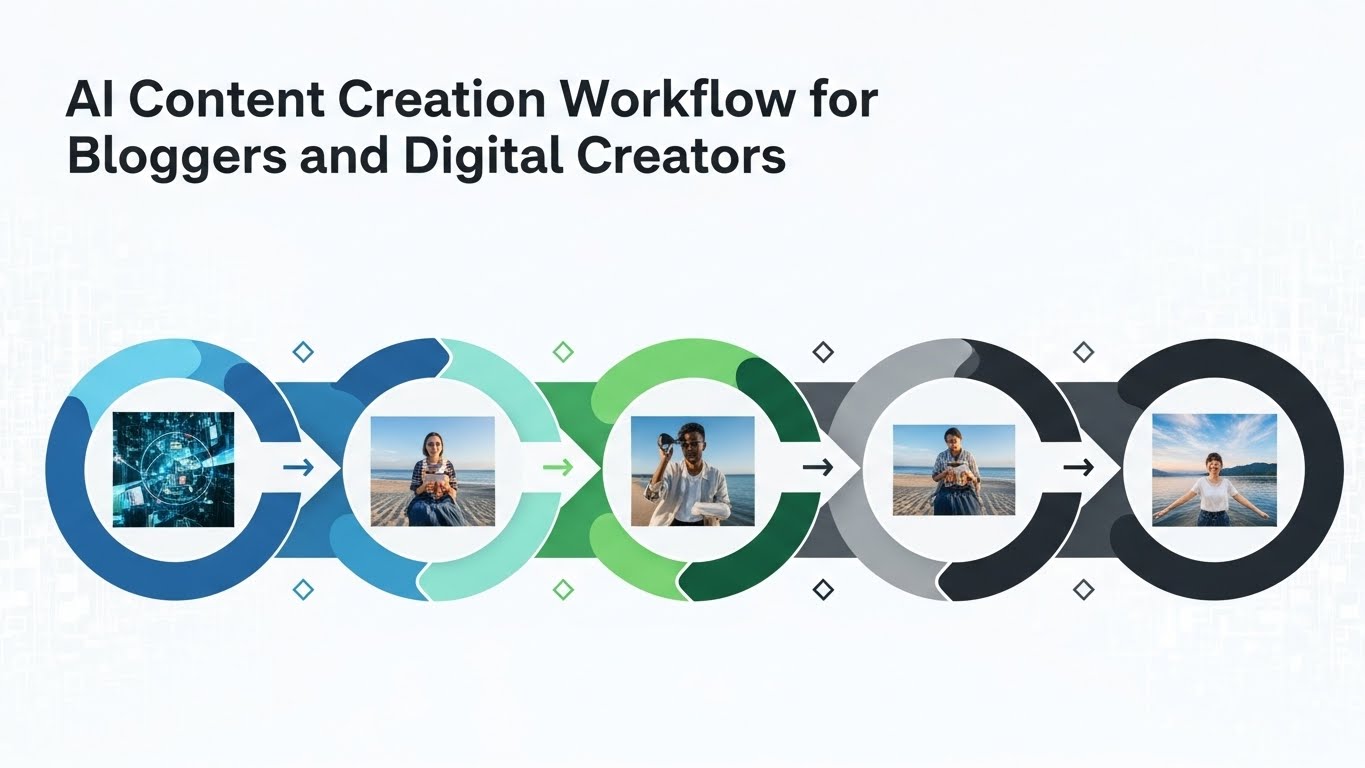
The secret to winning in 2026 isn’t just about using AI to write; it’s about mastering AI content creation as a multi-stage workflow that enhances your unique perspective while automating the mechanical heavy lifting.
If you are a blogger currently spending 10 to 15 hours on a single long-form post, this guide is your roadmap to cutting that time down to under 90 minutes without losing your voice, your authority, or your search engine rankings.
Part 1: The Philosophy of “Augmented Blogging”
Before we dive into the steps, we must address the mindset. Many bloggers approach AI content creation as a “vending machine”: you put in a prompt, and a finished blog post comes out.
This approach is dead.
Google’s algorithms and sophisticated readers can now spot “raw” AI output instantly. To create blog posts faster and more effectively, you must adopt the “Director Model.” You are the director; the AI is your highly skilled (but occasionally literal-minded) assistant.
The 70/20/10 Rule of AI Blogging
To maintain high standards, follow this ratio:
- 70% AI Production: Drafting, research synthesis, initial outlining, and SEO formatting.
- 20% Human Curation: Injecting personal anecdotes, fact-checking, and stylistic “soul.”
- 10% Strategy: Selecting the right topics and defining the unique “angle” that an AI cannot conceive on its own.
Part 2: Phase 1 – Intelligent Ideation and Topic Clustering
The most significant “time-leak” for bloggers is deciding what to write about. AI content creation begins long before the first word is typed.
Step 1: Using AI for Gap Analysis
Instead of searching for broad keywords, use AI to find “Information Gaps.”
- The Prompt Strategy: Feed a tool like Claude or ChatGPT a list of your top 10 competitors’ URLs (or their top article titles).
- Ask: “Analyze these titles in the [Niche Name] industry. Identify 5 high-intent sub-topics that are currently underserved or missing a unique perspective.”
Step 2: Generating Topical Authority Maps
Google rewards “Topical Authority.” You shouldn’t just write one post; you should write a cluster.
- Tool: Perplexity AI or ChatGPT with Search.
- The Action: Ask the AI to create a “Topical Map” for your primary keyword. It will generate 10-15 related post ideas that link together. This automates your content calendar for the next three months in seconds.
Part 3: Phase 2 – The AI-Powered Research Assistant
Research usually takes 30% of a writer’s time. AI can reduce this to 5%.
Step 3: Synthesizing Complex Data
If you are writing a technical or data-heavy post, don’t spend hours reading 50-page PDFs.
- Upload the documents to an AI with a large context window (like Claude 3.5 Sonnet).
- Ask for specific data points: “Extract all statistics related to [Topic] from this report and present them in a bulleted list with page citations.”
- Cross-Reference: Use Perplexity AI to find real-time, cited news or academic papers to ensure your post is up-to-date.
Part 4: Phase 3 – Crafting the “Unbreakable” Outline
A blog post lives or dies by its structure. A generic AI outline leads to a generic blog post.
Step 4: The Multi-Step Outlining Process
Don’t just ask for an outline. Give the AI a Structural Framework.
- Instruction: “Create an outline for a 2,500-word blog post on [Topic]. Use the ‘Problem-Agitation-Solution’ framework. Include an H2 for a ‘Case Study’ section and an H2 for ‘Common Misconceptions.’ Ensure the tone is authoritative yet conversational.”
Step 5: Incorporating Semantic SEO
Before you leave the outlining phase, use an SEO tool (like SurferSEO or NeuronWriter) to generate a list of NLP (Natural Language Processing) terms.
- The Action: Paste these terms into the AI and say: “Ensure that the following keywords are naturally integrated into the subheadings and section goals of this outline.”
Part 5: Phase 4 – High-Velocity Drafting (The “Chunking” Method)
The biggest mistake in AI content creation is asking the AI to “Write the whole blog post.” The AI will run out of “memory” (context), become repetitive, and lose the thread.
Step 6: The “Chunking” Technique
Draft your post section by section. This maintains high quality and detail.
- Introduction: Ask the AI for three different “hooks” (one anecdotal, one data-driven, one controversial). Choose the best one.
- Body Sections: Feed the AI the specific outline for only one H2 at a time.
- Context Injection: For each section, provide the AI with a “Personal Insight” nugget. (e.g., “In this section about SEO tools, mentioned that I personally found Tool X better for beginners because of its UI.”)
Step 7: Managing Voice and Tone
To avoid the “as an AI language model” vibe, use Voice Cloning prompts.
- The Action: Paste 500 words of your previous writing into the AI. Say: “Analyze the style, sentence length, and tone of this text. Create a ‘Style Profile.’ Use this profile to write the following sections.”
Part 6: Phase 5 – The Human-in-the-Loop (Editing for Excellence)
This is where you make the content “Google-proof.”
Step 8: The Fact-Check Audit
AI can hallucinate names, dates, and statistics.
- The Rule: Every number and every proper noun must be manually verified. Use AI to help: “Here is my drafted section. Find any specific claims made and provide a source for them or flag them if they seem inaccurate.”
Step 9: Injecting “Information Gain”
Google’s recent updates prioritize “Information Gain”—adding something to the internet that wasn’t there before.
- The Action: Look at your AI draft. Where can you add a personal screenshot? A custom chart? A quote from an interview you conducted? A unique analogy? This 10% effort provides 90% of the value.
Part 7: Phase 6 – SEO Optimization and Packaging
Step 10: AI for Metadata and Micro-Copy
Writing meta descriptions and title tags is tedious.
- The Prompt: “Generate 5 click-worthy SEO titles under 60 characters for this post. Then, write a meta description under 155 characters that includes the keyword [Focus Keyword] and a clear call to action.”
Step 11: Image Generation and Alt-Text
Use Midjourney or DALL-E 3 to create unique featured images that match your brand.
- Bonus Tip: Ask the AI to write the descriptive Alt-Text for these images to improve accessibility and image SEO.
Part 8: Advanced Workflow – Automating the “Massive” Blog
If you want to scale to 10+ posts per week, you need to link your tools.
Step 12: The “Make.com” / Zapier Integration
You can build a “Content Factory” where:
- A new row in a Google Sheet (with a Title and Keyword) triggers…
- ChatGPT to generate an outline…
- Which is sent to a Writer Agent to create the draft…
- Which is sent to WordPress as a “Pending Review” post.
This allows you to wake up to 5 drafted posts, leaving you only the “Expert Review” and “Voice Injection” stages.
Part 9: Overcoming Common AI Content Creation Obstacles
1. The “Repetitive Phrases” Problem
AI loves words like “tapestry,” “delve,” “unlock,” and “comprehensive.”
- The Fix: Create a “Negative Prompt” list. Tell your AI: “Never use the following words: delve, underscore, leverage, think of it as, in the rapidly evolving landscape…”
2. The “Short and Shallow” Problem
If the AI gives you 300 words for a section that needs 1,000, use the “Recursive Prompting” method.
- Ask: “This section is too brief. Expand on the third bullet point by providing three real-world examples and a step-by-step implementation guide.”
Part 10: Conclusion – The Future of the High-Speed Blogger
The goal of AI content creation isn’t to remove the human; it’s to free the human from the mundane. By following this step-by-step guide, you move from being a “word processor” to a “thought leader.”
You can now publish three high-quality, researched, and optimized posts in the time it used to take you to finish a single introduction. This increase in velocity, when paired with your unique human perspective, is the ultimate formula for blogging success in the AI age.
Your Action Plan:
- Select one tool from this guide (e.g., Claude or Perplexity).
- Apply the “Chunking Method” to your next blog post.
- Track your time. See the 50-70% reduction in production hours for yourself.
The era of slow blogging is over. It’s time to build your empire at the speed of thought.
Step-by-Step Summary Checklist:
SEO Keywords Integrated: AI content creation, how to create blog posts faster, AI for bloggers, step-by-step AI blogging, content automation, SEO blog optimization, AI writing workflow.