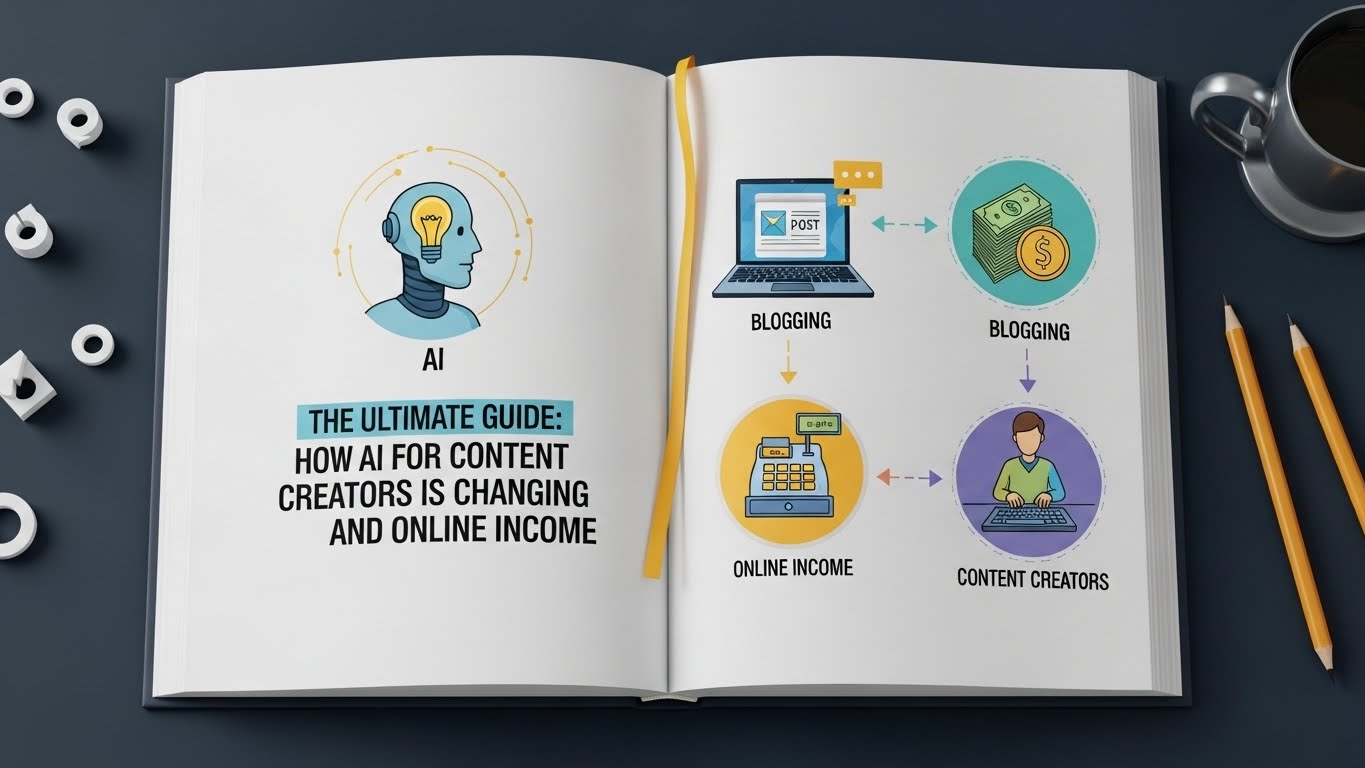
The digital world has reached a definitive turning point. For the last twenty years, the creator economy was built on the foundation of “individual bandwidth.” A blogger’s success was limited by how many words they could type per hour; a YouTuber’s growth was throttled by how many hours they spent in an editing suite; and a podcaster’s reach was capped by their ability to manually promote their work across a dozen different social platforms.
Today, that bottleneck has been shattered. We have entered the era of the AI-Augmented Creator.
The integration of Artificial Intelligence is not merely a “trend”—it is a fundamental restructuring of how digital media is produced, distributed, and monetized. Using AI for content creators is no longer a “cheat code”; it is a survival requirement in a market where the volume of content is exploding and the speed of information is near-instantaneous.
In this comprehensive 6,000-word guide, we will explore the profound shift in the blogging landscape, the new avenues for online income, the essential AI tools for creators, and the strategic framework you need to stay relevant in a future driven by algorithms and automation.
Part 1: The Evolution of the Content Landscape
From Manual Labor to Creative Direction
Historically, the barrier to entry for content creation was high. To be a successful blogger, you had to be a researcher, a writer, an SEO expert, a graphic designer, and a webmaster. To be a YouTuber, you had to add “cinematographer” and “sound engineer” to that list.
AI has democratized these skill sets. When we discuss AI content creation, we are talking about a shift in roles. The creator is no longer a manual laborer; they have become the Director. Like a film director who doesn’t hold the camera or build the sets but provides the vision and final approval, the modern creator uses AI to handle the execution while they provide the strategy, the unique perspective, and the “soul.”
The Rise of the Solopreneur Media Company
In the past, to produce a high-quality daily news show or a deep-dive educational blog, you needed a team of five to ten people. Today, a single individual utilizing a robust AI stack can out-produce a legacy media team. This “Solopreneur Media Company” model is the most profitable business structure of the decade, boasting near-zero overhead and massive scalability.
Part 2: How AI for Bloggers is Revolutionizing Written Content
Blogging was the first medium to feel the impact of Generative AI. While early critics claimed that “AI will kill blogging,” the reality has been the exact opposite: AI has breathed new life into it by allowing for deeper research and hyper-optimization.
1. Advanced Research and Fact-Synthesis
The traditional blogging process involved hours of Google searches, sifting through pages of results to find relevant data. AI for bloggers has streamlined this into “Fact-Synthesis.”
- Perplexity AI and Claude 3.5 Sonnet: These tools can digest massive amounts of real-time data, academic papers, and news reports, providing bloggers with summarized, cited information in seconds.
- Contextual Depth: Instead of broad generalizations, bloggers can now use AI to find niche statistics and specific case studies that make their content stand out as high-authority pieces.
2. Solving the “Blank Page” Crisis with AI Outlining
The hardest part of blogging is the start. AI excels at structured ideation.
- Topical Authority: AI tools can analyze a niche and generate a “Topical Map”—a series of 50 to 100 interlinked article ideas that prove to Google that your site is an expert on a subject.
- SEO-First Outlines: By feeding keywords into tools like SurferSEO or Jasper, bloggers can generate outlines that already include the necessary semantic terms (NLP) required to rank on the first page of search results.
3. The “Human-in-the-Loop” Drafting Process
The secret to making money with AI for content creators is avoiding the “Copy-Paste” trap. Google’s algorithms are increasingly sophisticated at identifying low-effort AI content.
- The 80/20 Workflow: Use AI to generate the first 80% (the structure, the definitions, the common knowledge). Spend your time on the final 20%—the personal anecdotes, the controversial takes, and the unique brand voice. This is where the “Expertise” and “Experience” (from Google’s E-E-A-T guidelines) come from.
Part 3: New Income Streams: How AI Drives Online Revenue
The goal of using AI is not just to “work less,” but to “earn more.” The efficiencies provided by AI content creation have opened up monetization models that were previously impossible for solo creators.
1. High-Velocity Affiliate Marketing
Affiliate marketing relies on traffic. The more helpful, review-oriented content you have, the more clicks you generate.
- The AI Edge: A creator can now launch ten niche sites instead of one. By using AI to generate product comparisons, “Top 10” lists, and buyer guides across different categories, creators can build a diversified “Affiliate Empire” with minimal manual writing.
2. “Faceless” YouTube Channels (The Automation Model)
YouTube is currently the most lucrative platform for creators, but many people are camera-shy.
- The Workflow:
- Script: ChatGPT.
- Voiceover: ElevenLabs (indistinguishable from a human).
- Visuals: Stock footage from Canva or AI video from Runway.
- Monetization: These channels earn through AdSense, but also through integrated affiliate links and digital product sales.
3. Rapid Digital Product Creation
Selling your own products (e-books, courses, templates) is the fastest way to scale online income.
- E-books: Use AI to help structure and draft 30,000-word guides in a week.
- Online Courses: AI can generate lesson plans, quiz questions, and even record the video lessons using an AI avatar (like HeyGen), meaning you don’t even need to be in the video.
4. AI-as-a-Service (Freelancing 2.0)
The freelancing market is changing. Instead of offering “Article Writing,” creators are offering “AI Content Strategy.”
- The Pivot: Businesses are desperate to know how to use AI. Creators who have mastered these tools are charging high-ticket retainer fees to set up AI content pipelines for traditional companies.
Part 4: Essential AI Tools for Creators: The 2026 Tech Stack
To succeed, you need a coordinated “stack” of tools. Here are the industry leaders categorized by function.
A. The “Brain” (Large Language Models)
- ChatGPT (OpenAI): The best all-rounder for brainstorming, coding, and general drafting.
- Claude (Anthropic): Widely considered to have the most “human” and creative writing style, perfect for long-form blogging.
- Perplexity AI: The best for real-time research and finding verified sources.
B. The “Visuals” (Images and Video)
- Midjourney: The gold standard for hyper-realistic and artistic image generation for blog headers and social posts.
- Canva Magic Studio: An essential all-in-one design suite that now features AI background removal, image expansion, and video editing.
- Runway Gen-3: The leader in text-to-video, allowing you to create cinematic b-roll for your video content.
C. The “Voice” (Audio)
- ElevenLabs: The most advanced voice cloning and text-to-speech platform on the market.
- Descript: A video/audio editor where you edit the media by editing a text transcript. It also features “Overdub,” which can fix mistakes in your audio by typing the correct words.
Part 5: Navigating the Ethical and SEO Landscape
As AI content creation becomes mainstream, the rules of the game are changing. Understanding the “SEO of the future” is critical.
Google’s Stance on AI Content
In 2024 and 2025, Google clarified its position: It does not care if content is AI-generated; it cares if it is helpful. However, “helpful” is a high bar.
- Information Gain: Google prioritizes content that adds something new to the internet. If your AI just summarizes the top 10 results, you will eventually lose your rankings.
- E-E-A-T: Experience, Expertise, Authoritativeness, and Trustworthiness. To make money online, your blog must prove you have real-world experience. This is why human editing is non-negotiable.
The Problem of Saturation
AI has made it easy to create “average” content. The result is a flood of mediocre blogs and videos. To win, creators must use AI to go deeper, not just broader.
- Strategy: Instead of using AI to write a 500-word post on “How to Bake Bread,” use AI to help you write a 5,000-word definitive guide that includes historical context, chemistry, local grain variations, and expert interviews.
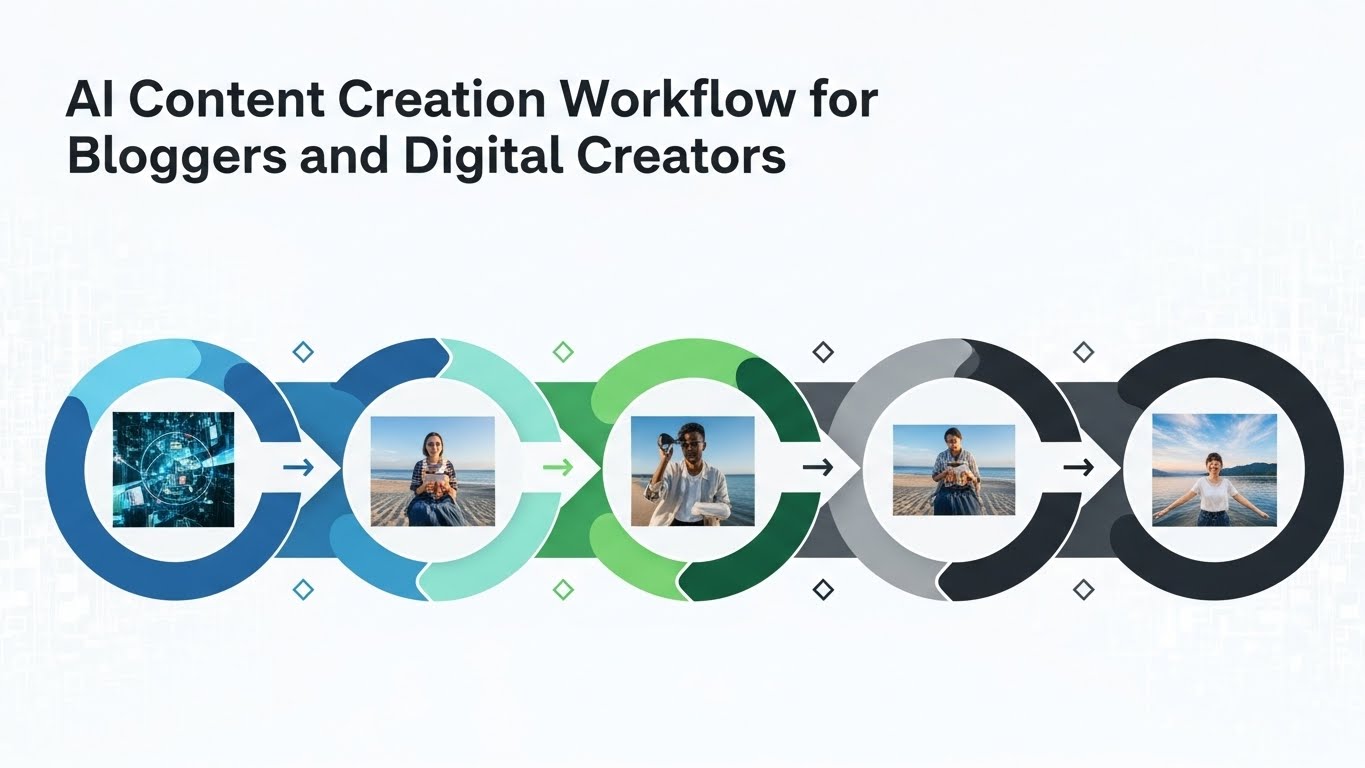
Part 6: Step-by-Step Workflow for the Modern Creator
How do you actually integrate this into your day-to-day? Here is a high-efficiency workflow.
- Ideation (10 mins): Use ChatGPT to analyze your niche and find 5 high-intent keywords that your competitors are missing.
- Research (20 mins): Use Perplexity to gather the latest data, quotes, and case studies for those topics.
- Outlining (15 mins): Use Claude to create a detailed H2/H3 structure based on the “Information Gain” principle.
- Drafting (45 mins): Have the AI draft the technical sections. You write the intro, the conclusion, and the personal stories.
- Visuals (15 mins): Use Midjourney to generate 3 unique, branded images for the post.
- SEO Check (10 mins): Use SurferSEO to ensure all NLP terms are present.
- Repurposing (20 mins): Take your finished blog post and feed it into OpusClip or Lumen5 to turn it into a short-form video for TikTok and Instagram.
Total Time: Approx. 2.5 hours for a piece of content that used to take 8–10 hours.
Part 7: The Future – Where is AI for Content Creators Going?
We are moving toward “Agentic Workflows.”
In the next 12–18 months, creators won’t just use tools; they will use “Agents.” These are AI programs that can perform multi-step tasks autonomously. For example, an agent will be able to:
- Monitor your competitors’ websites.
- Alert you when a new trend starts.
- Draft a response post.
- Generate the social media captions.
- Schedule everything in WordPress and Buffer.
The creator’s only job will be to hit “Approve.”
The Return of the Personal Brand
As AI-generated “faceless” content becomes ubiquitous, there will be a massive resurgence in the value of the Personal Brand. People will crave connection with real humans. The most successful creators will be those who use AI for efficiency but keep their face, their voice, and their personality at the center of their business.
Part 8: Conclusion – The Action Plan
The transition to AI for content creators is the greatest wealth-generation opportunity since the dawn of the internet. It has leveled the playing field, allowing anyone with a laptop and a vision to compete with global media conglomerates.
To start making money online today:
- Adopt the Tools: Don’t fear them. Start with a basic stack like ChatGPT Plus and Canva.
- Focus on Value: Don’t just produce volume; produce depth.
- Master Prompting: Learn how to talk to these machines to get the best output.
- Build Your “Owned” Audience: Use AI to drive traffic to an email list or a community that you own, protecting yourself from future algorithm shifts.
The future belongs to the augmented creator. The tools are here, the path is clear, and the opportunity is yours. It’s time to stop writing and start directing.