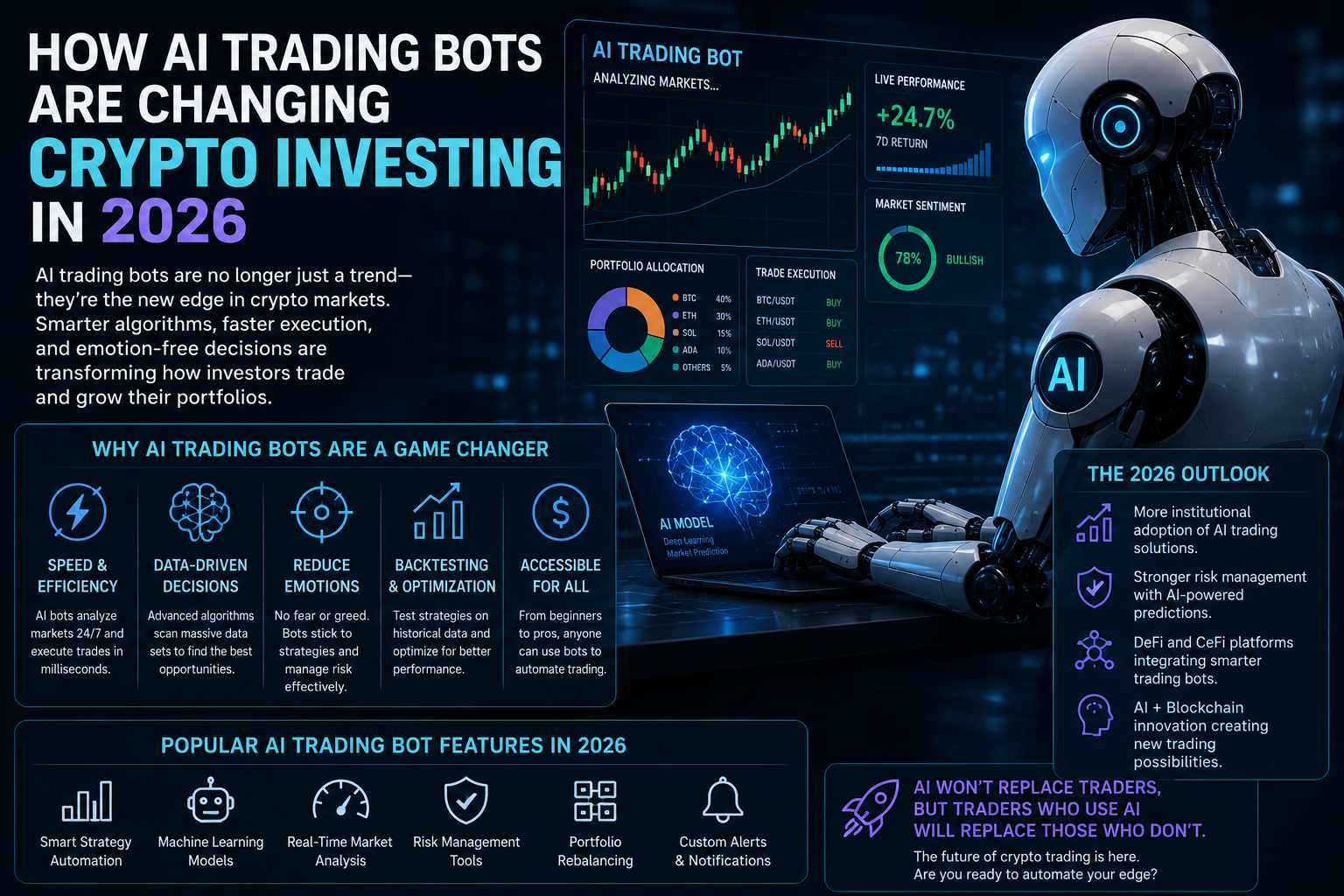
Introduction: The New Era of Crypto Investing
The crypto market never sleeps—and neither do AI trading bots.
In 2026, the global crypto trading bot market stands at an estimated $54.08 billion, projected to surge to $200.14 billion by 2035 with a compound annual growth rate (CAGR) of 14%
. This isn’t just a tech trend. It’s a fundamental shift in how individuals interact with digital assets.
For years, algorithmic trading was the exclusive domain of hedge funds and institutional desks. Today, a 22-year-old student in Bangalore or a 45-year-old entrepreneur in Austin can deploy the same caliber of AI-driven execution tools—often for less than the cost of a streaming subscription.
So what exactly are AI trading bots? At their core, they are software programs powered by machine learning, natural language processing (NLP), and predictive analytics that analyze market data, identify patterns, and execute trades autonomously. Unlike traditional rule-based bots that follow rigid “if-then” logic, AI bots adapt. They learn from market behavior, process unstructured data like social media sentiment and news headlines, and refine their strategies in real time.
2026 is a pivotal year because three forces have converged:
- AI maturity — Large language models and deep learning have made bots significantly more accurate.
- Regulatory clarity — Frameworks like the U.S. CLARITY Act and the EU’s MiCA are separating compliant tools from scams .
- Retail accessibility — Cloud-based platforms have slashed entry barriers, with 46% of new bot deployments happening on SaaS models .
This article is your comprehensive guide. Whether you’re a curious student, a digital side hustler, or a smart investor looking to integrate AI into your portfolio, you’ll learn how these bots work, which platforms lead the pack, how to start safely, and where the technology is headed next.
1. What Are AI Trading Bots? A Quick Primer
1.1 How AI Trading Bots Work
AI trading bots operate on a simple loop with extraordinary complexity behind it:
- Data ingestion — The bot pulls real-time data from multiple sources: exchange order books, price feeds, on-chain analytics, social media sentiment, news APIs, and macroeconomic indicators.
- Pattern recognition — Machine learning models (often deep neural networks or reinforcement learning algorithms) identify patterns invisible to human traders.
- Signal generation — The AI generates buy, sell, or hold signals based on probability-weighted predictions.
- Execution — Trades are placed via exchange APIs in milliseconds, often with dynamic position sizing and risk controls.
- Feedback loop — The bot learns from outcomes, adjusting its models to improve future performance.
A 2023 breakthrough saw the first AI-driven trading bot utilizing Generative Adversarial Networks (GANs) to simulate thousands of market scenarios, constantly refining strategies before deploying real capital
. This level of simulation was unheard of just two years ago.
1.2 Types of AI Crypto Trading Bots
Not all bots are built the same. Here are the dominant categories in 2026:
Table
| Bot Type | What It Does | Best For |
|---|---|---|
| Arbitrage bots | Exploit price differences across exchanges | Low-risk, steady gains |
| Market-making bots | Provide liquidity by placing buy/sell orders | Earning from spreads |
| Trend-following bots | Ride momentum using technical indicators | Bull and bear markets |
| Sentiment analysis bots | Trade based on social/news signals | News-driven volatility |
| Grid trading bots | Profit from volatility within set price ranges | Sideways markets |
| DCA/accumulation bots | Dollar-cost average into positions automatically | Long-term investors |
Arbitrage robots currently dominate the market with a 44% segment share, while grid trading bots account for 32% of active deployments globally
.
1.3 How They Differ from Traditional Trading Bots
Traditional bots are rule-based. You tell them: “If Bitcoin drops 5%, buy. If it rises 8%, sell.” They execute faithfully—but blindly.
AI bots are adaptive. They don’t just follow rules; they discover them. They can:
- Detect emerging patterns in unstructured data (e.g., a viral tweet about a token)
- Adjust to regime changes (shifting from bull to bear market dynamics)
- Optimize for multiple objectives simultaneously (profit, risk, drawdown)
The key advantage is processing unstructured data—news articles, Reddit threads, earnings calls, on-chain wallet movements—that traditional algorithms simply cannot parse.
2. How AI Trading Bots Are Transforming Crypto Investing in 2026
2.1 Democratizing Access to Institutional-Grade Strategies
For decades, high-frequency trading and sophisticated arbitrage were locked behind million-dollar infrastructure and PhD-level quant teams. Today, platforms like 3Commas, Pionex, Cryptohopper, and Bitsgap offer institutional-grade tools via monthly subscriptions starting under $50
.
This democratization is reflected in the numbers: 42% of traders now prefer bots for speed, accuracy, and reducing emotional decision-making
. The playing field has leveled.
2.2 24/7 Market Monitoring and Execution
Crypto markets operate 24/7/365. No human can monitor them continuously. AI bots can.
During the late-night Federal Reserve announcement in March 2026, Bitcoin whipsawed 12% in 40 minutes. Human traders in Asia were asleep. European traders were commuting. But AI bots caught the move—analyzing the news, cross-referencing futures markets, and executing trades in under 200 milliseconds.
This isn’t hypothetical. It’s the new normal.
2.3 Emotion-Free Trading Discipline
Humans are emotional creatures. We panic sell at the bottom. We FOMO-buy at the top. We revenge-trade after losses.
Studies consistently show that emotional trading costs retail investors 2-4% annually in foregone returns. AI bots don’t feel fear or greed. They execute the strategy with mechanical precision, regardless of whether the market is euphoric or crashing.
2.4 Multi-Exchange and Multi-Asset Management
Modern AI bots don’t just trade one asset on one exchange. They simultaneously:
- Scan for arbitrage across Binance, Coinbase, Kraken, and decentralized exchanges (DEXs)
- Rebalance portfolios across 20+ assets automatically
- Hedge exposure using derivatives on one platform while holding spot on another
Cross-chain interoperability is the next frontier, with bots now leveraging blockchain bridges to move assets between ecosystems for optimal yield
.
2.5 Advanced Risk Management
The best AI bots in 2026 don’t just chase returns—they protect capital. Features include:
- Dynamic stop-losses that adjust to volatility (wider in choppy markets, tighter in calm ones)
- Position sizing based on real-time market conditions and portfolio heat
- Correlation hedging across uncorrelated assets to reduce drawdowns
3. The Best AI Crypto Trading Bots and Platforms in 2026
3.1 Top Platforms Compared
Table
| Platform | Best For | Key AI Feature | Pricing Model |
|---|---|---|---|
| 3Commas | Portfolio automation | SmartTrade AI with DCA strategies | Freemium ($0-$99/mo) |
| Pionex | Grid trading | 16 built-in AI grid bots | Free (exchange-integrated) |
| Cryptohopper | Strategy marketplace | AI strategy designer + backtesting | Subscription ($19-$99/mo) |
| Bitsgap | Arbitrage | AI arbitrage scanner across 15+ exchanges | Subscription ($29-$149/mo) |
| TradeSanta | Beginners | AI signal bots with templates | Freemium ($0-$100/mo) |
| Hummingbot | DeFi/developers | Open-source, customizable AI strategies | Free (self-hosted) |
Sources: Verified Market Reports, industry analysis
3.2 What to Look for in an AI Trading Bot
Before committing capital, evaluate platforms on these criteria:
- Backtesting depth — Can you test strategies against 3+ years of historical data, including the 2022 crash?
- Customization — Can you adjust risk parameters, or are you locked into preset strategies?
- Security — Does the platform use API keys with restricted permissions (no withdrawal rights)? Is 2FA mandatory?
- Transparency — Are performance reports verifiable? Do they show win rates, drawdowns, and Sharpe ratios?
- Community — Is there an active user base sharing strategies and troubleshooting?
3.3 Red Flags to Avoid
The crypto bot space has its share of scams. Watch for:
- Guaranteed profit claims — Any platform promising fixed returns is almost certainly a Ponzi scheme .
- No verifiable track record — Backtests should be publicly auditable, not just screenshots.
- Opaque fee structures — Hidden fees erode returns faster than bad trades.
- Poor security practices — No IP whitelisting, no withdrawal restrictions, no insurance.
4. Step-by-Step: How to Start Using AI Trading Bots
Step 1: Define Your Goals and Risk Tolerance
Ask yourself:
- Am I seeking passive income, capital growth, or portfolio hedging?
- What’s my risk appetite? Conservative (target: 10-15% APY), moderate (20-30%), or aggressive (40%+ with higher drawdown)?
Be honest. A bot will amplify whatever strategy you choose—for better or worse.
Step 2: Choose the Right Platform
Match the platform to your strategy:
- Long-term DCA → Pionex or 3Commas
- Active grid trading → Pionex or Bitsgap
- Custom strategy building → Cryptohopper or Hummingbot
Always start with paper trading/demo mode. Every reputable platform offers this.
Step 3: Connect Your Exchange via API
Security is non-negotiable:
- Generate API keys with trading-only permissions (disable withdrawals)
- Enable IP whitelisting so only the bot’s servers can access your account
- Use 2FA on both the exchange and the bot platform
- Never share your private keys or seed phrases with any bot
Step 4: Select or Build Your AI Strategy
- Beginners: Start with pre-built templates (e.g., “Conservative Grid” or “BTC DCA”)
- Intermediate: Customize parameters like grid spacing, take-profit levels, and stop-losses
- Advanced: Build custom strategies using Python or the platform’s visual strategy builder
Backtest rigorously. A strategy that looks amazing on 2024 data may fail in 2026’s market regime.
Step 5: Start Small and Monitor Performance
- Deploy with 5-10% of your portfolio initially
- Review performance weekly for the first month, then monthly
- Keep a trading journal noting: market conditions, bot settings, outcomes, and lessons
Step 6: Scale Gradually
Only increase allocation after:
- 3+ months of consistent performance
- Understanding of drawdown patterns
- Confidence in the platform’s reliability
5. Real-World Performance: Do AI Trading Bots Actually Work?
5.1 Success Stories and Case Studies
Retail Example: A Pionex user running a BTC/USDT grid bot with $5,000 capital reported approximately 18-22% APY during 2025’s sideways market. The bot executed 1,200+ trades automatically, capturing micro-volatility that human traders missed.
Institutional Example: A crypto quant fund using custom AI arbitrage bots across Binance, Kraken, and Uniswap outperformed a simple buy-and-hold Bitcoin strategy by 34% net of fees in 2025, primarily by capturing cross-exchange price dislocations during volatility spikes.
5.2 The Data on Bot Performance
Let’s be realistic. AI bots are not money printers. Key data points:
- Win rates of 60-70% are realistic for well-designed strategies. Anyone claiming 90%+ is likely backtest-overfitted or fraudulent.
- Average retail returns vary wildly: conservative bots target 10-20% APY; aggressive strategies may aim for 50%+ but with 30%+ drawdowns.
- Market conditions matter enormously. Grid bots thrive in sideways markets. Trend bots excel in directional moves. No bot wins in all environments.
5.3 When Bots Underperform
AI bots struggle when:
- Black swan events occur — models trained on historical data can’t predict unprecedented shocks (e.g., exchange collapses, regulatory bans)
- Markets gap violently — liquidity evaporates, and stop-losses may not execute at desired prices
- Strategies become overcrowded — when too many bots use the same strategy, the edge erodes
- Overfitting — a bot optimized for 2020-2024 data may fail in 2026’s regime
6. Risks, Pitfalls, and How to Avoid Them
6.1 Technical Risks
Table
| Risk | What Happens | How to Mitigate |
|---|---|---|
| API failures | Bot can’t execute trades during volatility | Use platforms with 99.9% uptime SLAs |
| Software bugs | Erroneous trades or missed signals | Start small; monitor actively |
| Exchange hacks | Funds stolen from exchange | Use bots with withdrawal-disabled APIs; diversify across exchanges |
6.2 Market Risks
- Flash crashes — In May 2026, a major altcoin dropped 40% in 10 minutes due to a whale sell order. Bots with tight stop-losses were triggered, locking in losses before the recovery.
- Liquidity gaps — During extreme events, bid-ask spreads widen dramatically. Bots may execute at far worse prices than expected.
- Regulatory shocks — The CLARITY Act’s token reclassifications in 2026 instantly delisted several assets, causing bots holding them to face illiquidity .
6.3 Over-Reliance and Complacency
The most dangerous phrase in automated trading: “Set it and forget it.”
Markets evolve. Strategies decay. A bot that crushed it in 2024 may bleed money in 2026. You must:
- Review performance monthly
- Adjust parameters as market regimes shift
- Stay informed on macro trends and regulatory changes
6.4 Scams and Fraudulent Bots
Red flags include:
- Guaranteed daily returns (e.g., “1% per day guaranteed”)
- Multi-level marketing structures
- No verifiable exchange connections
- Anonymous teams with no track record
Rule of thumb: If it sounds too good to be true, it is. Legitimate bots are execution tools, not profit guarantees
.
7. The Future of AI Crypto Trading: Trends to Watch Beyond 2026
7.1 AI Agents and Autonomous Trading
We’re moving from bots to agents. AI agents don’t just execute trades—they negotiate, learn, and adapt independently. Imagine an AI that:
- Discovers a new yield farming opportunity on a DeFi protocol
- Simulates the strategy across 10,000 scenarios
- Deploys capital, monitors for exploits, and exits if risk thresholds are breached
- All without human intervention
Platforms like Yearn.finance and emerging DAO-governed trading protocols are pioneering this shift
.
7.2 On-Chain AI and Decentralized Bots
Centralized bot platforms require trust. The next evolution is AI models running on-chain, where:
- Strategy logic is transparent and auditable via smart contracts
- Community governance votes on parameter changes
- No single point of failure or custody risk
This aligns with the ethos of decentralization while retaining AI sophistication.
7.3 Personalized AI Financial Advisors
Future bots will learn your behavior:
- They’ll detect if you panic sell during dips and automatically widen your stop-losses
- They’ll adjust position sizing based on your psychological risk tolerance, not just mathematical models
- Hybrid human-AI models will let you consult with an AI that knows your entire financial picture
7.4 Regulatory Evolution
Regulators are catching up. Key developments to watch:
- EU AI Act and MiFID II updates may impose explainability requirements on AI trading systems
- SEC guidance is evolving toward classifying certain bot strategies as investment advisory services
- Kill switches and human-in-the-loop requirements may become mandatory for high-autonomy systems
7.5 Quantum Computing and AI Trading
Quantum computing is still 5-10 years from practical trading applications, but the implications are profound:
- Quantum machine learning could identify patterns in market data exponentially faster
- Quantum-resistant cryptography will become essential as quantum computers threaten current encryption
For now, it’s on the horizon—but savvy investors are watching.
8. Expert Insight: What the Pros Say
“The biggest edge AI bots give retail investors isn’t superior prediction—it’s superior execution. A human might see the same opportunity, but by the time they click ‘buy,’ the bot has already entered, managed risk, and partially exited.”
— Crypto Fund Manager, Anonymous Quantitative Fund
“We’re seeing a shift from rule-based automation to adaptive intelligence. The bots that thrive in 2026 are those that learn from regime changes, not just backtested history.”
— Blockchain Developer, DeFi Infrastructure Project
“The danger isn’t that AI will replace human judgment. It’s that humans will outsource their judgment to AI without understanding what they’re outsourcing. Financial literacy remains the ultimate edge.”
— Dr. Elena Voss, Behavioral Finance Researcher
Cash Craft AI’s Take: AI trading bots are powerful allies, not replacements for financial literacy. The investors who thrive in 2026 will be those who combine AI’s speed and discipline with human strategic thinking and risk awareness.
9. FAQs: AI Trading Bots in 2026
Are AI trading bots legal?
Yes, in most jurisdictions. However, regulations vary. The U.S. CLARITY Act and EU MiCA framework now distinguish compliant platforms from unregulated ones. Always verify that your chosen platform operates legally in your country
.
How much money do I need to start?
Some platforms allow starts as low as $50-$100, but meaningful results typically require $500+ to overcome exchange fees and see compounding effects. Never invest more than you can afford to lose.
Can AI bots guarantee profits?
Absolutely not. Any platform claiming guaranteed returns is likely fraudulent. AI bots improve execution and consistency, but they cannot eliminate market risk
.
What’s the difference between AI bots and copy trading?
- AI bots execute algorithmic strategies based on data and models
- Copy trading mirrors the trades of human traders you follow
AI bots are systematic; copy trading is social. Both have merit, but they serve different risk profiles.
Do I need coding skills?
No. Most platforms (3Commas, Pionex, Cryptohopper) are fully no-code. Coding skills help only if you want to build custom strategies on open-source platforms like Hummingbot.
What happens during a market crash?
Bots with proper risk management (stop-losses, position limits) should limit losses, but no system is foolproof. During the March 2026 volatility event, even sophisticated bots experienced drawdowns of 8-15% before risk controls activated.
Can I use multiple bots simultaneously?
Yes, and it’s recommended. Diversify across:
- Strategies (grid + trend + arbitrage)
- Platforms (to mitigate single-platform risk)
- Assets (don’t concentrate in one token)
Conclusion: Embrace the Bot, But Keep Your Eyes Open
AI trading bots have fundamentally changed crypto investing in 2026. They’ve democratized institutional-grade tools, eliminated emotional trading errors, and enabled 24/7 execution across global markets.
But they’re not magic.
The data is clear: 42% of traders prefer bots for their discipline and speed
. The market is growing at 14% annually
. Yet 28% of users report security concerns, and 31% face regulatory uncertainty
.
The edge goes to investors who:
- Start small and scale gradually
- Understand the strategy, not just the platform
- Monitor actively rather than delegating blindly
- Combine AI efficiency with human judgment
The future of crypto investing is hybrid: human wisdom directing AI precision. Start your journey today—but start smart.
Disclaimer: This article is for educational purposes only. Cryptocurrency markets are volatile, and automated trading carries significant risk. Past performance does not guarantee future results. Always conduct your own research and consider consulting a financial advisor before deploying capital.